
Comment mesurer les résultats de la formation en anglais dans votre entreprise
Budget season arrives and someone in leadership asks the awkward question. Is the English training actually working? Often the only answer HR can give is an attendance sheet and a satisfaction survey. Both are useful, but neither shows whether your people now handle a meeting, a call or a presentation better than before. If you want to measure English training results properly, you need more than that.
You do not need a complicated system. You need to decide what you will look at before the programme starts, measure it the same way every time and review it while the training is running, not only at the end.
This guide sets out five indicators HR can track from the first quarter, a simple review rhythm and a one-page way to report progress to leadership.
Why attendance is not enough
Attendance tells you whether people turn up. It does not tell you whether they learn, or whether they use what they learn. A group can have excellent attendance and still stand still because the levels are mixed or the content has nothing to do with their jobs. The opposite is also true. A drop in attendance in the second month is often the first sign that something does not fit.
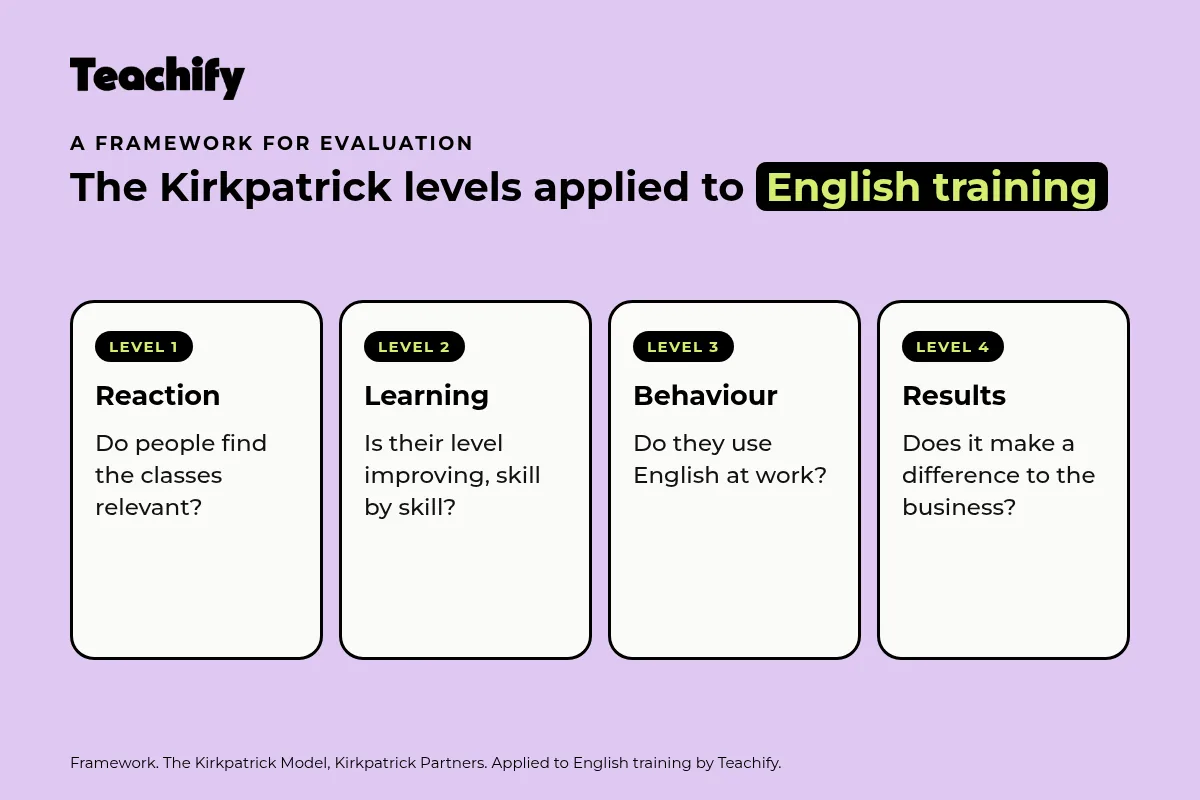
The best-known framework for evaluating training, the Kirkpatrick Model, was created by Donald Kirkpatrick in the 1950s and splits evaluation into four levels. Reaction, learning, behaviour and results. Satisfaction surveys only cover the first level. For English training, the levels translate into clear questions. Do people find the classes relevant? Is their level improving? Do they use English at work? Does it make a difference to the business?
Kirkpatrick Partners, who maintain the model today, make two points that matter for language programmes. Start by defining the results you want, and do not wait until the end to measure. Checks during the programme let you correct course while there is still time.
Before you measure, set the baseline
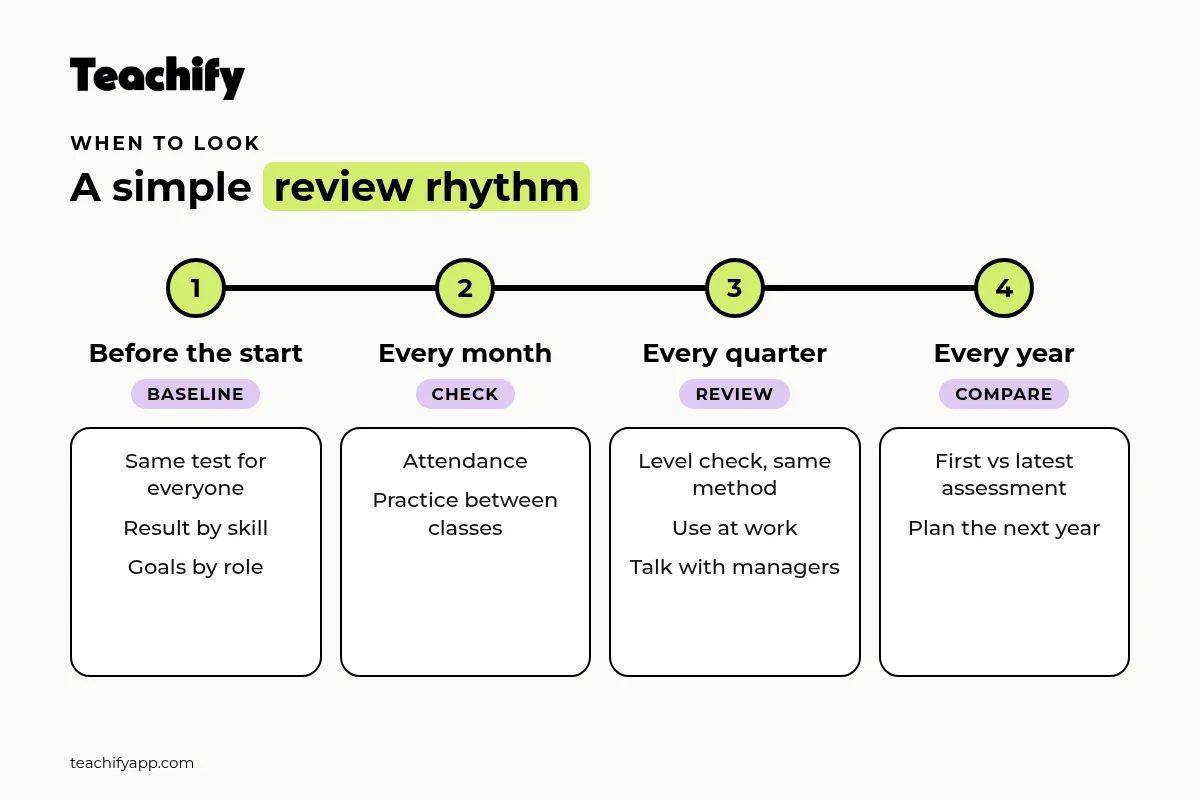
No progress indicator works without a starting point. Before the first class, do three things.
- Assess everyone with the same method, for example a written level test followed by a short live speaking assessment.
- Record the result by skill. “B2 reading, B1 speaking” is far more useful than a single overall grade.
- Define what each role needs to do in English. Follow a meeting, present results, negotiate with a supplier, answer emails without help.
The CEFR, the Council of Europe framework behind levels A1 to C2, defines each level through “can-do” descriptors, which makes it a good common language between HR, managers and teachers. Our guide on comment évaluer le niveau d’anglais des employés walks through the process step by step.
Five indicators worth tracking
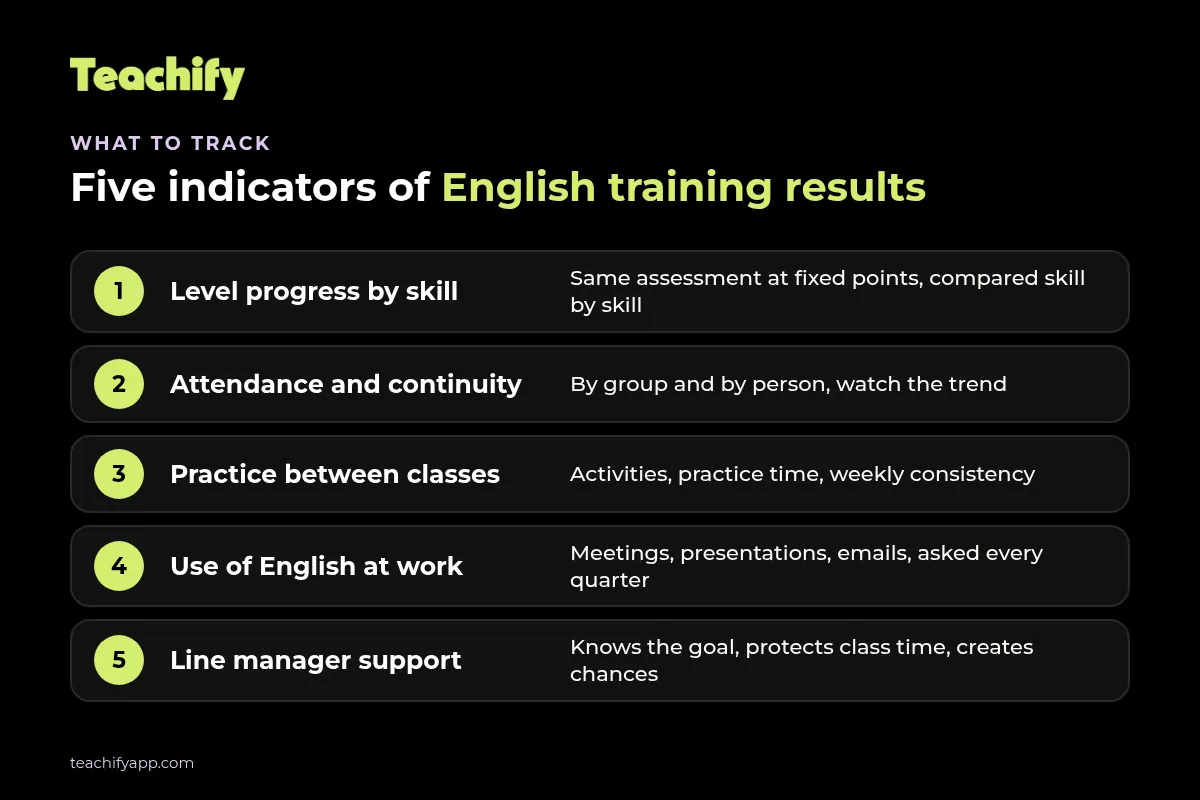
1. Level progress by skill
This is the core indicator. Repeat the same assessment at fixed points, for example every quarter, and compare skill by skill. Keep the pace realistic. Cambridge English estimates about 200 guided learning hours to move from one CEFR level to the next. Two hours of class a week over 40 weeks adds up to 80 hours a year, so in one quarter you should expect progress within a level, not a jump from B1 to B2. Measuring by skill makes that progress visible.
2. Attendance and continuity
Look at it by group and by person, and above all at the trend. Stable attendance is a good sign. A steady fall calls for a conversation about the schedule, the group level or workload. We cover the habits that keep people coming in comment maintenir le niveau d’engagement des employés dans la formation en entreprise.
3. Practice between classes
Cambridge English lists study and exposure outside lessons among the factors that affect how fast people progress. If your programme includes a practice app or platform, track its use. Activities completed, practice time and weekly consistency. It is a useful leading indicator, because it moves before level scores do.
4. Use of English at work
This is the indicator leadership cares about most and the one companies measure least. It is Kirkpatrick’s behaviour level, and it does not need anything sophisticated. Each quarter, ask the learner and their line manager about specific situations.
- Have they joined meetings or calls in English that they used to avoid?
- Have they presented something in English?
- Do they write emails without asking for help or using a translator?
Answers to concrete questions say far more than a satisfaction score out of ten.
5. Line manager support
When managers know the goal, protect class time and create chances to use English, training moves forward. When they do not, what people learn stays in the classroom. Once a quarter, ask each manager whether they know their team’s goal and whether there has been a chance to put it into practice.
How often to review
- Every month. Attendance and practice between classes. Ten minutes is enough to spot groups that are slipping.
- Every quarter. A level check with the same method, the questions on use at work and a short review with each manager. This is the moment to move someone to another group or adjust the content.
- Every year. Compare the first and the latest assessment by person, group and department, and use it to plan the next year.
What matters is reviewing while the programme is running. A perfect report in December does not help much if the problem started in March.
How to report it to leadership
Leadership does not need every data point. They need one page that answers three questions.
- How many people trained, and how consistently? People, groups and average attendance.
- Have they improved? The share of people who moved up a level or sub-level, by skill.
- Does it show at work? Two or three concrete examples of English used on the job, anonymised if needed.
If you also need to translate this into financial terms, our article on the ROI of business English training sets out a simple way to calculate it. The indicators in this guide are the evidence that calculation rests on.
Common mistakes when measuring
- Measuring only at the end. By the final test, nothing can be fixed.
- Changing method between assessments. If the first test was written and the last one a conversation, the results are not comparable.
- Relying on one overall grade. It hides what is happening skill by skill, which is exactly what tells you what to adjust.
- Setting unrealistic targets. Expecting a full level in one quarter makes good progress look like failure.
- Leaving managers out. They are best placed to say whether anything has changed day to day.
How Teachify tracks progress
Chez Enseigne-moi, every programme starts with an initial assessment, a written level test followed by a short oral assessment of five to ten minutes. During the training, monthly check-ins adjust the learning path, and a quarterly evaluation measures overall progress. Classes are live and online with experienced teachers, in groups of up to four learners at the same level or one-to-one, and companies can add 24/7 access to the Teachify app for practice between sessions. You can see how the formats work on our page des cours and in our guide to online English classes for employees. If you are still deciding on the format, see cours de groupe ou privés d'anglais.
Foire aux questions
How often should we assess employees’ English level?
Évaluez tout le monde avant le début de l’entraînement, puis à des points fixes, par exemple tous les trimestres, en utilisant la même méthode que la première fois afin que le comparatif soit juste.
Combien de temps faut-il pour passer d'un niveau d'anglais à un autre ?
Cambridge English estime qu’il faut environ 200 heures d’apprentissage guidé pour passer d’un niveau du CEFR à un autre. C’est une estimation indicative. L’apprentissage précédent, l’intensité et les activités pratiques en dehors du cours modifient tous le rythme.
Quel indicateur importe le plus ?
Le niveau de progrès selon les compétences, combiné à des questions concrètes sur l’utilisation de l’anglais au travail. Ensemble, ils permettent de déterminer si les personnes apprennent et si cela se reflète dans leur travail.
Est-ce que une enquête de satisfaction suffit ?
Non. La satisfaction vous aide à repérer les problèmes liés au format ou à l’adaptation d’un groupe, mais elle ne mesure pas l’apprentissage ou l’utilisation de l’anglais au travail. Dans le modèle Kirkpatrick, elle n’est que le premier de quatre niveaux.
Comment cela diffère-t-il du calcul du retour sur investissement ?
ROI turns results into money. The indicators in this guide show whether learning and behaviour are changing, which is the evidence any ROI figure depends on. Track the indicators first and calculate ROI once you have data.
Votre prochaine étape d'apprentissage
Commencez par une évaluation initiale de chaque apprenant et bénéficiez de cours en ligne avec des enseignants expérimentés dès la première session. Pas de perte de temps inutile. Seul résultat : des résultats. → Réservez un rendez-vous
Passez à l'étape suivante
Measuring English training does not need a complex system. A clear baseline, five indicators, a fixed review rhythm and one page for leadership are enough to know what is working and fix what is not. If you want help setting up the tracking for your next programme, Réservez un rendez-vous avec notre équipe B2B.