
How to Keep Employees Engaged in Company English Training
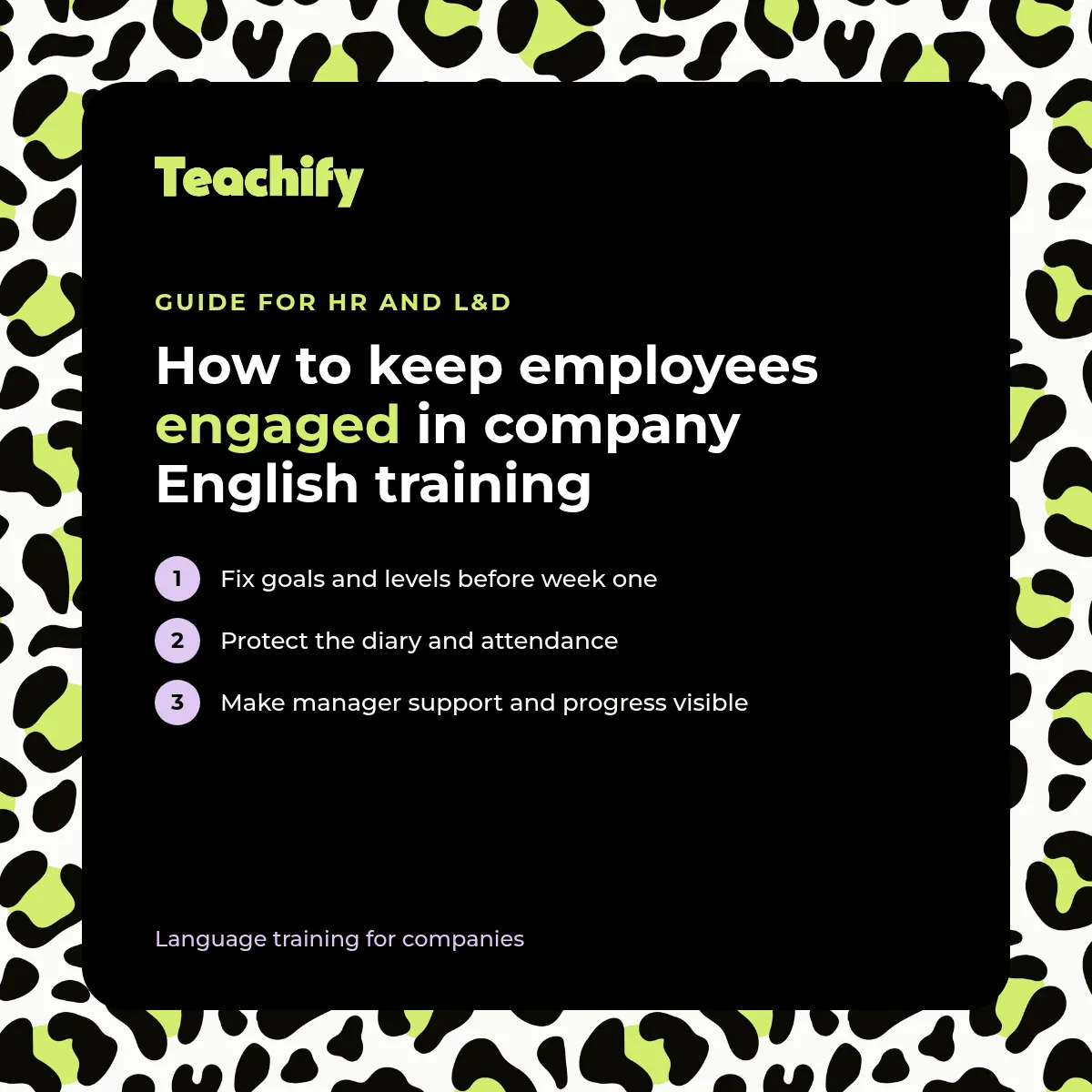
Most company English programmes do not collapse because the teachers are weak. They fade when people cancel class after class, when goals stay fuzzy and when nobody on the team talks about progress for months. If you want to keep employees engaged in English training, you treat attendance, relevance and manager support as design choices, not as luck.
Engagement is not a mood. It is a set of habits that make showing up easier than dropping out. This guide shows where motivation usually breaks, what to fix before week one and how to protect the diary once classes start.

Why engagement in English training fails
Time pressure is the main barrier
Across the OECD, among adults who face barriers to adult learning, lack of time due to work or family responsibilities is the most common reason, at about 48%. Lack of suitable training sits around 14%, and cost around 13%. That pattern matters for HR. If English sits outside the working day with no protection in the calendar, busy people will treat it as optional, even when they want to improve.
Much adult learning also happens in the workplace and in paid hours, and employer support is a strong predictor of participation. Protected slots during work are not a perk. They are how you remove the biggest barrier on the list.
Manager support still decides who stays
The CIPD Good Work Index 2025 found that the share of employees saying their line manager supports their learning and development rose to 64% from 57% in 2023. That is progress, yet a large minority still do not feel that support. Only 60% of managers say they have the training and information to manage people well, and 59% say they have the time. CIPD learning research has long stressed that line managers shape whether learning transfers into day-to-day work. Without a short, regular signal from the manager, English becomes something HR bought, not something the job expects.
Relevance and invisible progress
People disengage when lessons feel generic or when months pass with no clear feedback. Vague goals such as “improve English” do not survive a busy quarter. Visible milestones do.
Fix the design before week one
Set goals by role, not by wishful thinking
Ask what each person must do in English in the next six to twelve months. Client calls, board updates, supplier emails and internal meetings all point to different targets. Write those targets in plain language and share them with the learner and the manager. Role-based goals make classes feel useful from the first session.
Group by level before you form classes
Mixed levels drain motivation fast. A B2 speaker next to an A2 learner leaves one bored and the other lost. Assess skills properly, then place people with peers at a similar level. Our guide on how to assess employees’ English level walks through that process. Cambridge English estimates about 200 guided learning hours to move up one CEFR level, so realistic timelines also help people stay patient instead of quitting early.
Choose a format people can keep
Fixed group slots build habit. Flexible private lessons fit unpredictable diaries, but they are easier to postpone. Many companies combine both. For the trade-offs, see group or one-to-one English classes.
Protect the diary once classes start
Treat English like any other recurring work meeting. Book the slot in company calendars. Ask managers not to schedule over it. Agree a clear cancellation rule, for example that last-minute moves need a new date in the same week. Logical as it sounds, protected calendar slots help attendance more than reminders alone.
For groups, a steady weekly rhythm of one or two sessions is easier to defend than irregular blocks. For private lessons, agree a minimum frequency before the programme starts so flexibility does not become endless delay.
The manager's job in ten minutes a month
You do not need managers to teach English. You need them to signal that the programme matters. Once a month, a short check-in is enough.
- Ask what the person practised and where they used it at work.
- Name one upcoming situation in English and treat the class as preparation for it.
- Notice attendance without turning it into a performance review.
- Share feedback from the provider so progress feels shared, not private.
CIPD research on learning at work highlights the line manager’s role in learning transfer. Ten minutes of that attention often does more for engagement than another motivational message from HR.
Make progress visible
People stay longer when they can see movement. Build a simple review cycle into the programme.
- Initial assessment. Confirm starting level and goals before classes begin.
- Monthly check-ins. Adjust topics, pace or format while motivation is still high.
- Quarterly evaluation. Measure progress against the role goals you set at the start.
At Teachify, every programme starts with an initial assessment, with monthly check-ins and a quarterly evaluation. Group classes have a maximum of four learners at the same level, once or twice a week at fixed times. Private classes can follow a flexible or fixed schedule. In group programmes, participants can be added or removed at no extra cost if the group stays at four or fewer and everyone shares the same level. Levels run from A2 to C1+. You can see how formats work on our classes page.

A practical HR checklist
Use this list before launch and again at each quarterly review.
1. Goals written by role and shared with each learner and manager.
2. Levels assessed and groups formed only at the same level.
3. Class slots in company calendars with a clear cancellation rule.
4. Managers briefed on a ten-minute monthly check-in.
5. Monthly check-ins and a quarterly evaluation booked from day one.
6. A way to move people between formats when the fit stops working.
7. Practice between classes encouraged, even in short blocks.

If you also need a wider business case for the budget, our guide on the ROI of business English training sets out how companies think about return. For a short practice rhythm between sessions, see How to Improve Your Business English in 90 Days.
Frequently asked questions
How do you keep employees engaged in English training when diaries are full?
Protect the slot in the working day and treat it as a recurring meeting. OECD data shows lack of time is the most common barrier among adults who face obstacles to learning. Flexible private lessons help some roles, but a fixed group habit often survives busy weeks better.
How much should line managers do?
A short monthly conversation is enough for most teams. Ask what improved, name one upcoming English-heavy moment and keep attendance visible. CIPD findings show manager support for learning rose to 64% in 2025, yet many managers still say they lack time or training to manage people well.
Should English classes sit inside working hours?
Where possible, yes. Much adult learning already happens in the workplace and in paid hours, and employer support predicts participation. Classes that compete with evenings and family time lose people first.
How often should you review progress?
Monthly check-ins keep the path relevant. A quarterly evaluation shows whether people are moving toward role goals. Cambridge English’s guided learning hours estimate of about 200 hours per CEFR level also helps set expectations so nobody expects a full level jump in a few weeks.
What if motivation drops after the first months?
Check the three usual causes first. Diary clashes, weak manager signals and goals that no longer match the job. Fix those before you change providers. Often the format or grouping needs a tweak, not a full restart.
Start with an initial assessment for every learner and work with native teachers from the very first class. No wasted time. Just results. → Book a call
Engagement is built before the first class and protected every week after. If you want help designing goals, grouping by level and locking a rhythm your team can keep, book a call with our B2B team.