
Online English Classes for Employees. How to Make Them Work
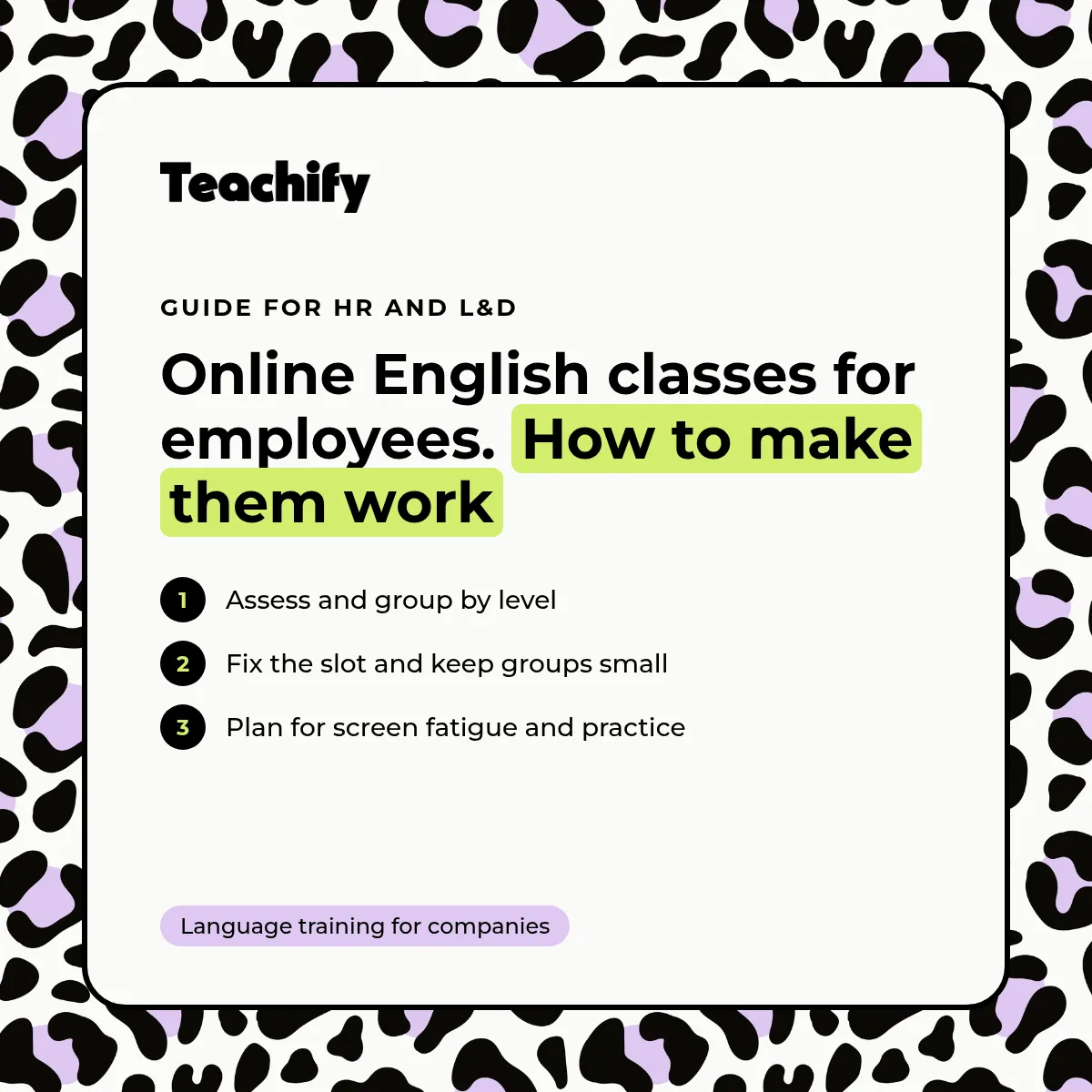
Online English classes for employees solve a real problem. Teams sit in different offices, some people work from home part of the week and nobody wants to lose an hour travelling to a classroom. A live class on a laptop removes most of that friction.
Removing friction is not the same as creating progress, though. Some online programmes turn into silent video calls with cameras off and one person talking. Others become a busy, speaking-led hour that people protect in their diaries. The difference is rarely the platform. It is how the programme is designed.
This guide explains why online classes suit today’s companies, how live classes, apps and blended set-ups compare, and the six things HR should get right before the first session.

Why online English training suits today's companies
Work is spread across places
Eurostat’s Labour Force Survey shows that in 2025 about 23% of employed people aged 20 to 64 in the EU worked from home at least sometimes. In France the figure was about 36%, and in Spain about 16%. When part of a team is at home on any given day, a class that only works in a meeting room loses people every week. An online class follows the learner instead.
Online learning already feels normal
Eurostat also tracks how many people take courses online. In 2025, 27% of people aged 16 to 74 in Spain had done an online course in the previous three months, against an EU average of about 16% and about 11% in France. For many employees, learning through a screen is no longer new, so the first barrier is not technology. It is habit and attention.
The research points to design, not the medium
A large meta-analysis prepared for the US Department of Education compared online and face-to-face learning across dozens of studies. On average, learners in online conditions did modestly better, and the largest gains came from blended designs that mixed online and face-to-face elements. The authors were careful to add that those blended set-ups often included extra learning time and extra activities, so the gains should not be credited to the medium itself. For HR, that is the key lesson. Online works when the design adds speaking time, feedback and practice, not just a video link.
Live classes, apps or blended
Live online classes with a teacher
A live class gives people what an app cannot fully replace. Real conversation, a teacher who corrects mistakes as they happen and the social pressure of a fixed appointment. For speaking skills in meetings, calls and presentations, this is usually the core of the programme.
Self-paced practice on an app
Apps are good for short, regular practice. Vocabulary, pronunciation drills and quick speaking exercises fit into a commute or a ten-minute gap. On their own, they rarely keep busy adults going for months, because nobody notices when a learner stops opening the app.
Blended programmes
Most companies get the best of both by combining them. Live classes set the rhythm and the speaking practice, and short practice between sessions adds learning time. Cambridge English estimates about 200 guided learning hours to move up one CEFR level, and notes that study and exposure outside lessons affect how fast people progress. Practice between classes is not an extra. It is part of the timeline.
Six steps to make online classes work
1. Assess first and group by level
Online does not fix a mixed-level group. A B1 learner next to a C1 speaker will switch off, whether the class is in a room or on a screen. Start with a proper assessment and place people with peers at the same level. Our guide on how to assess employees’ English level walks through the process.
2. Fix the slot and protect it
The flexibility of online classes is also their weak point. A class that can move anywhere often moves nowhere. Book group sessions at a fixed time in company calendars and ask managers not to schedule over them. For private lessons, agree a minimum frequency. We cover diary habits in more detail in how to keep employees engaged in company English training.
3. Keep groups small and speaking-led
In a large video call, most people listen. In a small group, everyone speaks. Ask any provider how many learners join each class, how much of the hour learners spend talking and how the teacher brings quieter people in. If you are still choosing a format, see group or one-to-one English classes.
4. Get the set-up right
A laptop, a stable connection, a headset and a quiet place are enough for most people. Sound matters more than video. A learner on a noisy open-plan floor will speak less. Where possible, let people join from a small meeting room or from home rather than from their desk.
5. Plan for screen fatigue
Stanford researcher Jeremy Bailenson has argued that video calls tire people for four reasons. Excessive close-up eye contact, extra cognitive load, constantly seeing yourself on screen and being stuck in one position. A few simple choices help. Avoid placing class straight after a run of back-to-back calls, encourage people to hide their self-view and keep the class active with role-play and short tasks rather than long explanations.
6. Add practice between sessions
Short, regular practice keeps the language active between classes. Give learners something specific to use at work, such as an email they will write or a call they will lead, and ask the teacher to build the next class around it.

How Teachify runs online classes
At Teachify, classes are live and online, led by experienced teachers, in groups or one-to-one. Group classes have a maximum of four learners at the same level and meet once or twice a week at fixed times. Private classes can follow a flexible or fixed schedule. Each learner receives a link to the virtual classroom, and a computer and internet connection are all they need. Sessions focus on speaking first, with systematic correction, repetition, dialogues and role-play.
Every programme starts with an initial assessment, followed by monthly check-ins and a quarterly evaluation. Levels run from A2 to C1+. Companies that want practice between classes can add 24/7 access to the Teachify app, which offers real-time feedback and speaking practice. You can see how the formats work on our classes page.

Mistakes to avoid
- Treating online classes as a webinar where one person talks and the rest listen.
- Letting flexible scheduling turn into constant postponing.
- Mixing levels to fill a slot.
- Relying on an app alone and hoping people keep going.
- Measuring logins instead of progress against role goals.
Frequently asked questions
Are online English classes as effective as face-to-face classes?
Research comparing online and face-to-face learning, including the US Department of Education meta-analysis, found online learners did at least as well on average, with the strongest results in blended designs. The authors linked those gains to extra learning time and activities rather than the medium. A well-designed live online class with a small group and plenty of speaking can work very well.
How many people should be in an online English group?
Small enough that everyone speaks in every class. In larger video calls most people stay silent. At Teachify, group classes have a maximum of four learners at the same level.
Should employees keep their cameras on?
Cameras help the teacher read reactions and keep the class interactive, so they are worth encouraging. To reduce fatigue, people can hide their own self-view, and teachers can vary tasks so nobody stares at the screen in the same position for an hour.
Can an English learning app replace live classes?
For most companies, no. Apps are useful for short practice between sessions, but live classes provide conversation, correction and a fixed rhythm. Combining both adds learning time, which matters when one CEFR level takes about 200 guided learning hours.
What equipment do employees need?
A computer, a stable internet connection and ideally a headset and a quiet place to speak. For Teachify classes, each learner receives a link to the virtual classroom.
Start with an initial assessment for every learner and live online classes with experienced teachers from the very first session. No wasted time. Just results. → Book a call
Take the next step
Online English classes work when the design does the heavy lifting. Level-based groups, protected slots, a speaking-led class and practice in between. If you want help setting up a programme your teams will actually attend, book a call with our B2B team.