
How to Run an English Training Needs Analysis in Your Company

How to run an English training needs analysis in your company, five steps from business goals to targets by role, a Teachify guide for HR and L&D

Many company English programmes start with the same request. Someone in leadership says the team needs better English, HR books a course, and a few months later nobody is quite sure whether it is working. The problem is rarely the classes themselves. It is that nobody defined what better English meant for each role before the training started.

An English training needs analysis fixes that. It is a short, structured piece of work that tells you who needs English, for which tasks, at what level and how urgently. With that in hand, choosing formats, setting goals and reporting progress becomes much easier.

This guide covers the three levels to look at, a five-step method you can run yourself, useful questions and common mistakes.


What a needs analysis is, and what it is not


A needs analysis is not the same as a level test. A level test tells you where each person is today. A needs analysis tells you where each person needs to be, for what, and how big the gap is.

The CIPD, the UK professional body for HR and people development, describes learning needs analysis as starting from the organisation’s current and future capability needs, then assessing existing skills and knowledge, and prioritising the gaps within the wider business strategy. That logic fits English training well. Start with the business, not with the course catalogue.

Research on language needs analysis points the same way. In Second Language Needs Analysis, published by Cambridge University Press, Michael Long argues that the most useful unit of analysis is the task, what people actually have to do in the language, rather than lists of grammar or vocabulary. He also notes that people often struggle at work not because of missing grammar, but because they cannot yet handle the specific tasks their job requires.


Three levels to look at


The CIPD suggests that needs can be analysed for the whole organisation, for a specific department, project or team, and for individuals, and that the three should be read together rather than in isolation. For English training this works as follows.

  • Organisation. Where is the business going? New markets, international clients, an English-speaking parent company or a new tool used in English all create needs.
  • Team or department. What does each team do in English? Sales may present and negotiate, support may write emails and handle calls, finance may report to a group in English.
  • Individual. What does each person do, how often, and how comfortable are they doing it today?
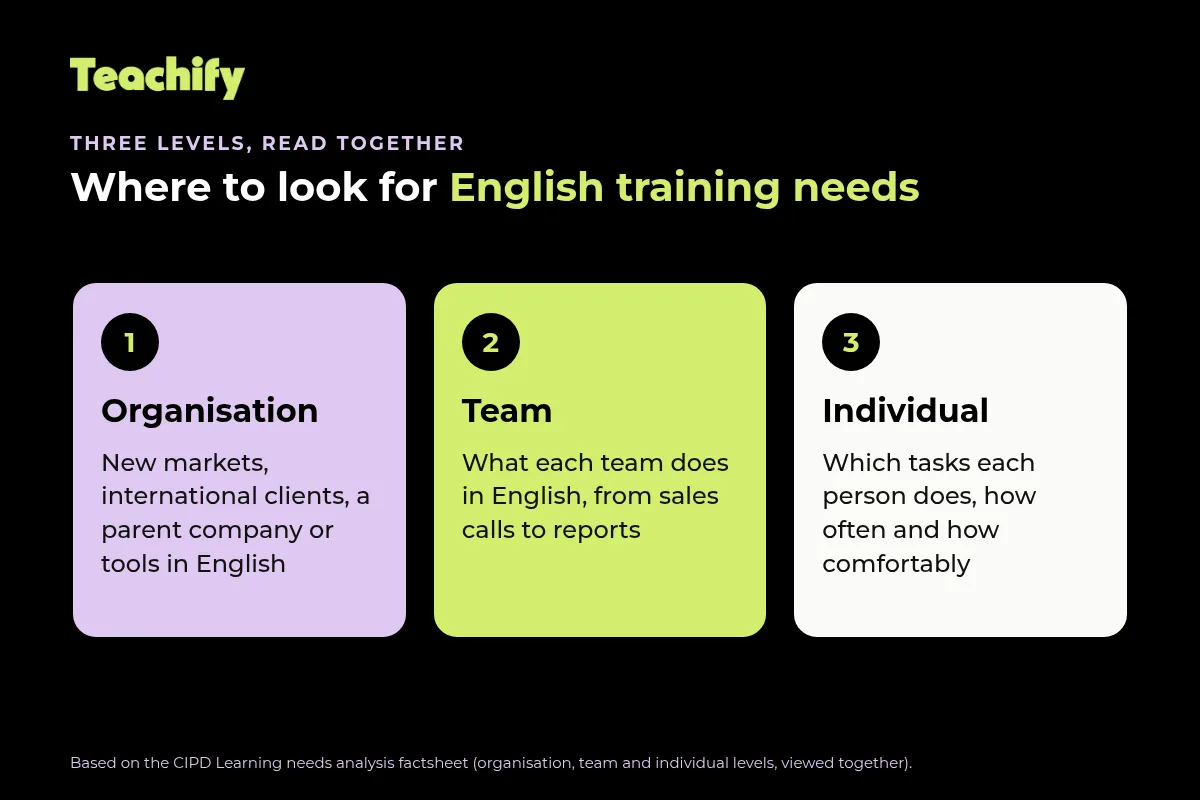
Three levels of an English training needs analysis, organisation, team and individual, based on the CIPD learning needs analysis factsheet


How to run it in five steps


1. Start from business goals

Ask leadership two simple questions. What will the business need people to do in English over the next year or two, and what is not working today because of English? Write the answers down as concrete situations, such as presenting results to the group or answering client emails without help, not as general wishes.

2. List the tasks people do in English

For each team, list the real tasks done in English and how often they happen. Following meetings, leading a call, writing reports, negotiating or reading technical documents. A task list is far more useful than a statement like “needs business English”, because it tells teachers exactly what to practise.

3. Gather information from more than one source

Do not rely on a single survey. Long recommends combining sources, such as the learners themselves and people who know the work well, and methods, such as interviews, questionnaires and observation, then comparing the results. In a company, that means asking employees, their managers and, where possible, a colleague who works with the team in English. The CIPD lists a similar mix of methods for workplace needs analysis, including interviews, focus groups, observation, surveys and existing performance information.
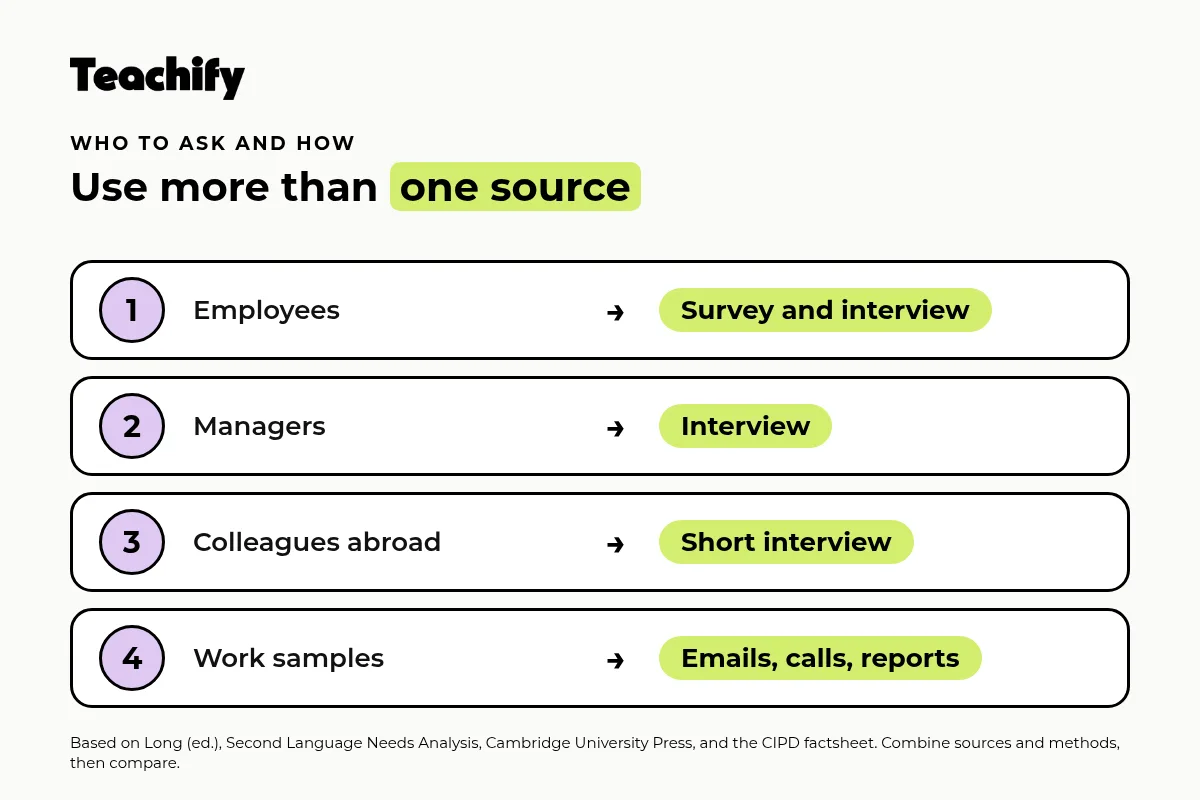
Who to ask and how in an English training needs analysis, employees, managers, international colleagues and real work samples, based on Long and the CIPD

4. Assess the current level by skill

Now measure where people are. Speaking, listening, reading and writing can be very uneven in the same person, so a single overall level hides useful detail. Our guide on how to assess employees’ English level explains how to do this properly.

5. Set targets by role and prioritise

Compare the tasks with the current level and decide the target for each role. The CEFR, the Council of Europe framework with six levels from A1 to C2, offers can-do descriptors you can use to describe targets in plain language. Its 2020 Companion Volume added scales for online interaction and for mediation, such as relaying information or explaining data to others, which are close to everyday work. Not every gap is equally urgent, so prioritise the roles where English has the biggest business impact. To turn a level gap into a realistic timeline, see how long it takes employees to move up an English level.
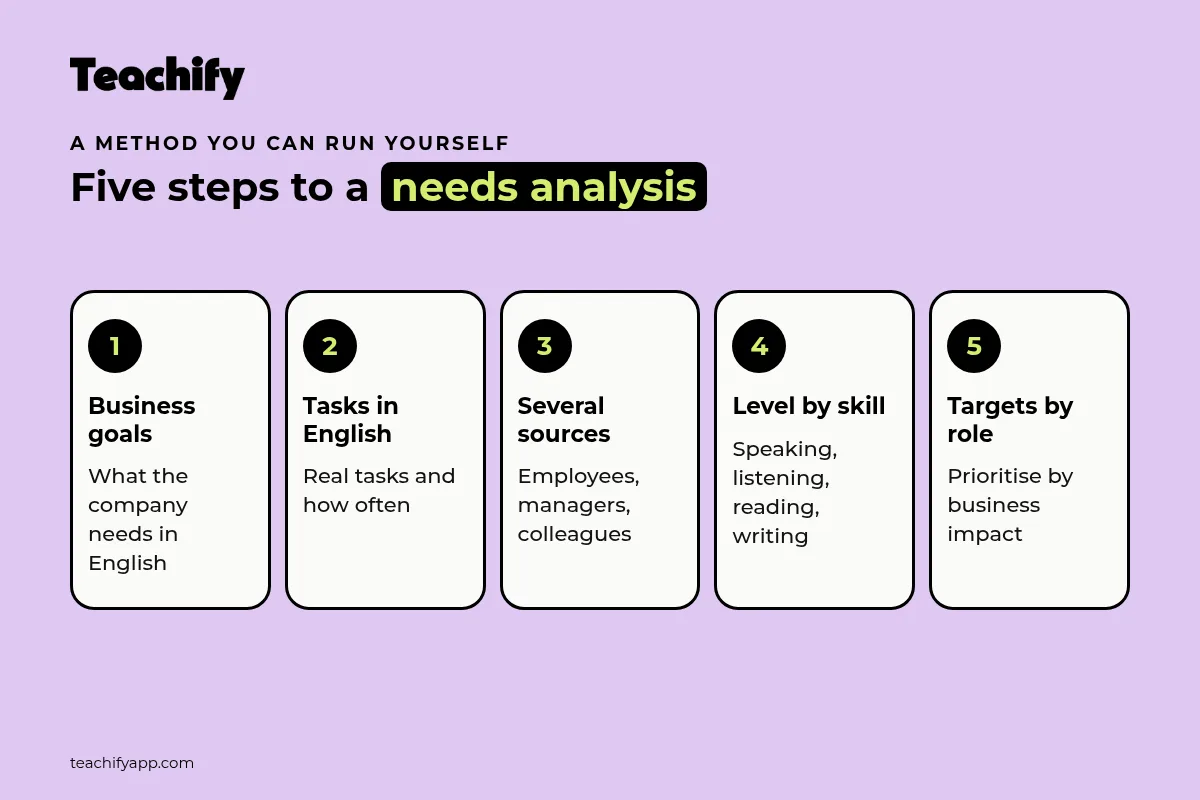
Five steps to run an English training needs analysis, business goals, tasks in English, several sources, level by skill, targets by role

Questions worth asking


A short questionnaire and a few interviews are usually enough. These questions work for employees and adapt easily for managers.

  • Which tasks do you do in English, and how often?
  • Which of those tasks do you find hardest today?
  • Who do you speak or write to in English, and in what situations?
  • Have you avoided or delegated a task because of English in the last few months?
  • Which skill would make the biggest difference to your work right now?
  • How much time could you realistically give to training each week?


Common mistakes to avoid


  • Asking only whether people want English. Interest is useful, but it does not tell you what the job requires.
  • Using one level for everyone. A support team and a sales team rarely need the same target or the same content.
  • Skipping the managers. They see the tasks that go wrong and the ones that are coming.
  • Treating it as a one-off. The CIPD stresses that needs analysis works best as an ongoing process aligned with the business. Review it when roles, markets or tools change.


Turning the findings into a training plan


A good needs analysis makes the next decisions almost obvious. Group people with similar tasks and levels, and decide where one-to-one classes make more sense. Our guide to group or one-to-one English classes helps with that choice, and if your teams work across several offices, see online English classes for employees.

Then use the targets you set as the basis for reporting. If the analysis says a team must be able to run client calls in English, progress should be measured against that, not only against a test score. Our article on how to measure English training results sets out a simple review rhythm, and how to keep employees engaged in company English training covers the habits that keep people attending.


How Teachify fits in


At Teachify, every programme starts with an initial assessment, a written level test followed by a short oral assessment of five to ten minutes. During the training, monthly check-ins adjust the learning path and a quarterly evaluation measures overall progress. Group classes have up to four learners at the same level and meet once or twice a week on fixed schedules, while private classes can follow a flexible or a fixed schedule. Classes are live and online with experienced teachers, and companies can add 24/7 access to the Teachify app for practice between sessions. You can see how the formats work on our classes page.


Frequently asked questions


What is an English training needs analysis?

It is a structured review of which employees need English, for which tasks, at what level and with what priority. It combines business goals, the real tasks people do in English and an assessment of their current level.

How is it different from a level test?

A level test shows where each person is today. A needs analysis also defines where each role needs to be and how important that gap is for the business. You need both to plan training well.

Who should take part?

Employees, their managers and, where possible, colleagues who work with them in English. Research on language needs analysis recommends combining several sources and methods instead of relying on a single survey.

How long does a needs analysis take?

It depends on the size of the company and how many teams are involved. A short survey, a handful of interviews and a level assessment are usually enough to start, and the analysis can be refined as the training runs.

How often should we repeat it?

Review it whenever roles, markets or tools change, and at least when you plan the next training cycle. The CIPD recommends treating needs analysis as an ongoing process rather than a one-off exercise.

Your Next Learning Step

Start with an initial assessment for every learner and live online classes with experienced teachers from the very first session. No wasted time. Just results. → Book a call


Take the next step


An English training needs analysis does not need to be complicated. Start from business goals, list the real tasks, ask more than one source, assess by skill and set targets by role. The result is a plan that leadership understands and teachers can use from day one. If you want to talk through your findings and how to turn them into a programme, book a call with our B2B team.

Fun, flexible classes for real-life results

Book your FREE call today !

Teachify for your business,

try it for free