
How Long Does It Take Employees to Move Up an English Level?
It is one of the first questions leadership asks when a company invests in English training. If the team is at B1 today, when will they be at B2? HR often has to answer with a guess, and a guess that is too optimistic turns good progress into a disappointment six months later.
There is a better starting point. Cambridge English publishes guideline figures for how many hours it takes to move up an English level, and they are a solid base for planning. They are not a promise, and the pace changes a lot from person to person, but they turn a vague hope into a plan you can explain.
This guide covers what the hours really mean, what they look like in months for A2 to B1 and B1 to B2, what speeds progress up and how to agree realistic goals with leadership.
The short answer, about 200 hours per level
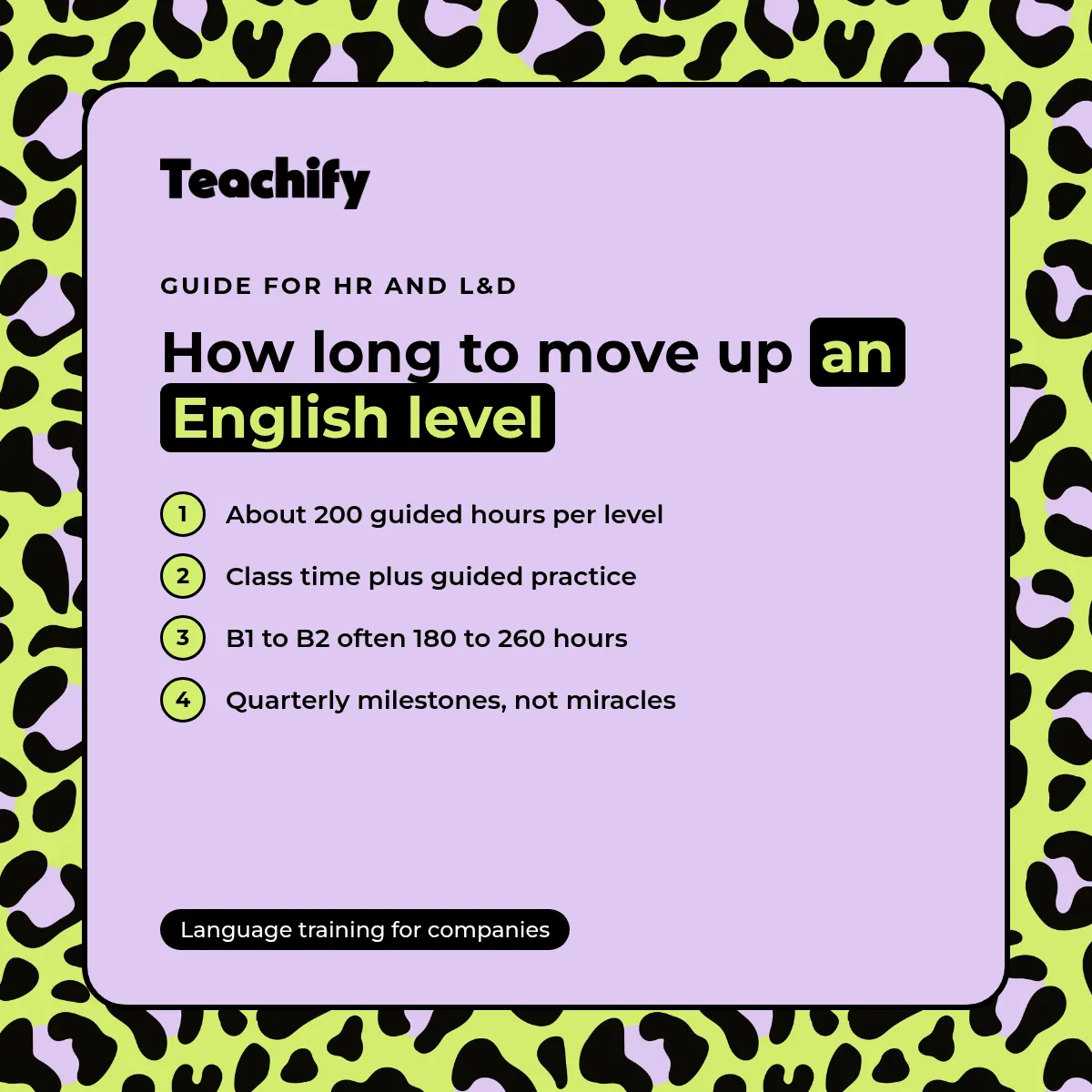
Cambridge English states that it takes approximately 200 guided learning hours for a learner to progress from one level of the CEFR to the next. The CEFR is the Council of Europe framework that describes six levels, from A1 to C2.
Guided learning hours are not just class hours. Cambridge counts time in class plus guided study, such as homework and practice activities designed by the teacher. That matters when you plan, because a programme with two hours of class a week and no practice in between moves more slowly than the number of class hours suggests.
Cambridge also gives cumulative figures from complete beginner. About 180 to 200 hours to reach A2, 350 to 400 for B1, 500 to 600 for B2 and 700 to 800 for C1. They describe these figures as a guideline only. Some people need more time and some need less.

What that means for your teams
From A2 to B1
Going by the Cambridge cumulative figures, the gap between A2 and B1 is roughly 150 to 220 guided hours. At this stage progress tends to feel visible. People start to follow simple meetings, write routine emails and handle predictable calls with more confidence.
From B1 to B2
This is the jump most companies ask for, and it is often slower than expected. In a Cambridge research article, Ben Knight, Director of ELT Research at Cambridge, explains that motivated adult learners typically need 100 to 200 guided hours per level, and that the step from B1 to B2 can take 180 to 260 hours. Cambridge also describes the familiar plateau at intermediate level, where learners feel they are no longer moving as fast as they did at the start.
The weekly maths
Divide the hours by what each person actually does per week. Around 200 guided hours means roughly 100 weeks at two hours a week, about 67 weeks at three hours, 50 weeks at four hours and 40 weeks at five hours, without counting holidays or busy periods. This is simple arithmetic, not a forecast, but it shows why a single weekly class rarely gets someone from B1 to B2 within one year.

What speeds progress up
Cambridge lists four factors that affect how long it takes to increase your level. Language learning background, the intensity of study, age, and study and exposure outside lessons. HR cannot change the first or the third, but the programme design can support the other two.
Regular, protected sessions
Intensity counts. Sessions that happen every week at a fixed time add up, while classes that are often cancelled or moved lose hours that are hard to recover. Protecting the slot in people’s calendars is one of the simplest things leadership can do to help.
Practice outside class
Cambridge notes that learners who do significant extra self-study should progress faster, and that at higher levels people can make more use of English outside the classroom, from reading online to communicating with colleagues. Short, regular practice between classes, through an app, guided exercises or real tasks at work, adds hours without adding meetings.
The right format for each person
Groups give people the chance to practise with peers at the same level, while one-to-one classes give each learner all the speaking time and full flexibility. Neither is faster in every case. Our guide to group or one-to-one English classes helps you decide which fits each profile, and if your teams are spread across offices, see online English classes for employees.
Staying in the programme
Hours only count if people keep coming. A level gained over a year needs steady attendance through busy months. We cover the habits that help in how to keep employees engaged in company English training.
How to set realistic goals with leadership
- Start from an assessment by skill. You cannot plan a timeline without a starting point. Our guide on how to assess employees’ English level explains how.
- Agree the target level by role. Not everyone needs B2. Define what each role must do in English, such as following meetings, presenting or negotiating.
- Do the hours maths together. Show leadership the gap in levels, the guided hours that gap usually takes and the weekly hours the programme provides. The timeline follows from those three numbers.
- Set quarterly milestones within a level. Progress in specific skills, such as speaking or writing, is visible long before a full level change.
- Report progress the same way every time. Use the same assessment method at fixed points. Our article on how to measure English training results sets out a simple review rhythm.

Expectations worth resetting
- “A full level in one quarter.” With a couple of hours a week, that is very unlikely. Expect progress within the level.
- “Everyone will move at the same pace.” Background and practice outside class vary, and so does progress.
- “Class hours are all that count.” Guided practice between sessions is part of the hours Cambridge describes.
- “A plateau means the training has stopped working.” The intermediate plateau is a known pattern. It is a reason to adjust the content or the practice, not to give up.
How Teachify supports steady progress
At Teachify, every programme starts with an initial assessment, a written level test followed by a short oral assessment of five to ten minutes. During the training, monthly check-in s adjust the learning path and a quarterly evaluation measures overall progress. Group classes have up to four learners at the same level and meet once or twice a week on fixed schedules, while private classes can follow a flexible or a fixed schedule. Classes are live and online with experienced teachers, and companies can add 24/7 access to the Teachify app for practice between sessions. You can see how the formats work on our classes page.
Frequently asked questions
How many hours does it take to move up one English level?
Cambridge English estimates approximately 200 guided learning hours to move from one CEFR level to the next. That includes class time and guided study such as homework. It is a guideline, and the real figure depends on each person.
How long does it take to go from B1 to B2?
Cambridge research suggests that motivated adults can need about 180 to 260 guided hours to go from B1 to B2. In months, it depends on how many hours each person studies per week, including practice outside class.
Can employees move up a level in three months?
With one or two hours of class a week, a full level in three months is very unlikely. A quarter is a good period to measure progress in specific skills within a level.
Does practice outside class really make a difference?
Yes. Cambridge lists study and exposure outside lessons among the factors that affect how long it takes to move up, and notes that learners who do significant extra study should progress faster.
Are one-to-one classes faster than group classes?
Not always. One-to-one classes give each person more speaking time and flexibility, and groups at the same level add peer practice. The right choice depends on goals, schedules and level.
Your Next Learning Step
Start with an initial assessment for every learner and live online classes with experienced teachers from the very first session. No wasted time. Just results. → Book a call
Take the next step
Moving up an English level takes time, and that is fine when everyone knows what to expect. A clear starting point, a target level by role, honest hours maths and quarterly milestones turn English training into a plan leadership can trust. If you want help building that plan for your teams, book a call with our B2B team.